Texas Stock Exchange will be a fully electronic, national securities exchange that will seek registration with the U.S. SEC. A venue to trade and list public companies and the growing universe of ETFs
Securitiex on Substack is a Darwinex Zero Affiliate Partner
ASSETS YOU CAN TRADE: Currencies, Indices, Commodities, Treasuries, Bitcoin (CME and Eurex) US Stocks/ETFs (Cboe) and CFDs
Join Darwinex Zero and transform your strategy into an investable index with certified track record (use the code DZ20OFF for 20% off): DZ20OFF
☑️ #14 Jan 31, 2025
Texas Stock Exchange Startup Asks SEC to Clear 2026 Launch
wsj.com: [Excerpt] With $160 million in funding from Wall Street heavyweights, TXSE seeks to take on New York as a financial hub.
A new stock exchange has just officially filed paperwork in hopes of gaining regulatory approval to start listing companies next year, seeking to capitalize on the President Trump-led backlash against regulations and cultural pressures on businesses.
The details
The Texas Stock Exchange, or TXSE (pronounced “tex-ee”), has been courting investors and pitching its business for months, and asked the Securities and Exchange Commission on Friday to approve its creation.
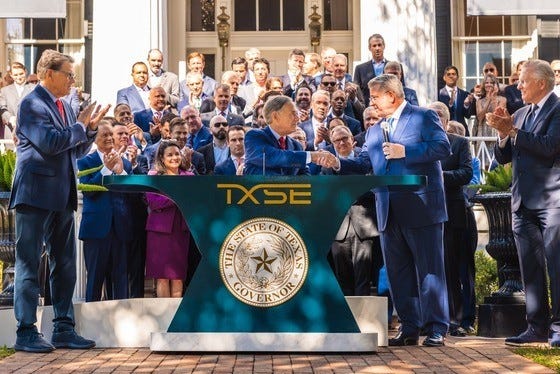
Texas Gov. Greg Abbott announcing in September plans for the Texas Stock Exchange. PHOTO: BOB DAEMMRICH/ZUMA PRESS
txse.com: [Excerpt] Texas Stock Exchange files Form 1 registration to operate as a national securities exchange.
In addition, TXSE Group Inc announced that it has closed its initial capital raise at $161 million, making TXSE the most well-capitalized exchange to ever file a Form 1. Its founding investors represent all major sectors in the markets: liquidity providers, retail and institutional investors, and business leaders from across the country. They include BlackRock, Citadel Securities, Charles Schwab, Dell Family Office Management, Fortress, Jump Trading, Squarepoint, Susquehanna Private Equity Investments, Tower Research, and other market leaders.
History of efforts to start a stock exchange in Texas:
The idea for a Texas-based stock exchange is not new.
State and regional stock exchanges were common until the 1920s (Houston Chronicle, 2015).
In fact, until the 1920s, the Houston Stock Exchange operated in downtown Houston (Houston Chronicle, 2015).
In 1968, the Texas legislature commissioned a study on the feasibility of a Texas Stock Exchange (Legislative Reference Library of Texas, 1968).
In 2020, executives from the Nasdaq and the NYSE met with Texas state leadership to discuss the possibility of moving their data centers from New Jersey to Texas (Yahoo Finance, 2020).
In 2021, Stacey Cunningham, the head of the NYSE, penned an op-ed in the Wall Street Journal publicly warning that the exchange could move to Texas if New York instituted a financial transaction tax (Dallas Morning News, 2021).
Both New Jersey and New York have weighed levying a financial transaction tax on stock transfers (Tax Foundation, 2020).
Texas Gov. Greg Abbott supports a state constitutional amendment to bar any attempts to institute a financial transaction tax in the future (Dallas Morning News, 2021).
txse.com: [Excerpt] TXSE is proud to have industry veterans Cam Smith and Jeff Brown among its top executives. Smith has spent decades at the intersection of trading, regulation, compliance, and innovation and serves as TXSE's global head of trading and co-president. Brown was acting general counsel at Charles Schwab and serves as general counsel of TXSE Group Inc and chief regulatory officer of the exchange. TXSE’s corporate listings team is led by Nicole Chambers, who covered the Texas market for Nasdaq for nearly 17 years, and Jeff Karcher and Marc Cunningham, who covered the southeast U.S. and Texas during long careers with the New York Stock Exchange.
TXSE also aims to drive innovation and efficiency for investors. To lead that effort, Rick Yoder joined TXSE as chief technology officer after serving as director of software development at Intercontinental Exchange Data Services. Exchange veterans Jonathan Ross and Adrian Falcone are lead architect and developer and head of technology operations, respectively. Ross previously served as chief technology officer at Nasdaq, and Falcone's past experience includes tenure as technical operations engineer at the Members Exchange. Additionally, Bob Kenny serves as senior software developer after working in data services and development at Nasdaq and Intercontinental Exchange.
TXSE Group Inc's board of directors includes legendary Texas business leaders such as Tom Long, co-chief executive of Energy Transfer (NYSE: ET), and Paul Foster, who founded Western Refining and oversaw its growth into a Fortune 200 company. Foster is currently the founder and chief executive of Franklin Mountain Investments. Tyson Tuttle, former chief executive of semiconductor manufacturer Silicon Labs (NASDAQ: SLAB), also serves on the board.
The board is honored to include the longest-serving governor of the state of Texas, the Honorable Rick Perry, who also served as U.S. Energy Secretary. Rick Roberts, a former commissioner at the U.S. Securities and Exchange Commission, and Alex Bussandri, global head of strategy at Citadel Securities, sit on the board as well. BlackRock Vice Chairman Mark McCombe serves as a board observer.
In addition to its leadership team and board, TXSE Group Inc is supported by seasoned market and policy experts serving as strategic advisors. Richard Fisher, former president of the Federal Reserve Bank of Dallas, leads the Texas Stock Exchange Listing Standards and Governance Advisory Council, an esteemed group of Wall Street experts. Brett Redfearn, former director of the SEC's division of trading and markets, brings deep technical and regulatory knowledge to inform the development of TXSE's ruleset. Securities industry experts Harvey Cloyd and Alex Goor leverage their experience building exchange infrastructures to shape TXSE's growth. Finally, public affairs expert Bill Lauderback advises TXSE's relationships with key stakeholders.
The Governor was joined at the press conference by TXSE Group Inc. Founder and CEO James Lee, former U.S. Secretary of Energy Rick Perry, Senator Tan Parker, Representative Giovanni Capriglione, Representative Morgan Meyer, and other business and community leaders.
Why BlackRock is Building a New Stock Market... In Texas
@HowMoneyWorks: The (overdue) replacement of Wall Street
Last week Blackrock (the world's largest asset manager), and Citadel Securities (the world's largest hedge fund) teamed up to make a major announcement that could reshape global financial markets. They were going to team up to create a new wall street… in Texas.
These two companies have the financial muscle to make a “Texas Stock Exchange” viable, but the question is… why? The startup exchange that will be located in Dallas is already taking shots to challenge the dominance of the New York Stock Exchange and the NASDAQ which are both located in New York City and are by far the largest exchanges in America, and also the largest exchanges in the world. Both of these incumbents are private businesses that make money by providing a place where public stocks and other financial instruments can be traded securely.
They make their money by charging companies that want to list on their exchange a one time IPO fee and an ongoing annual fee. The New York Stock Exchange is really not much different to a farmers market where businesses will pay the market organizer for the right to sell their stuff in a place with lots of customers. The only difference is that instead of beets, and artisanal honey, they are selling shares in their company. If the New York Stock Exchange is like a farmers market then the NASDAQ is like ebay, it’s still a marketplace but it’s all done online.
The NYSE is owned by a company called Intercontinental Exchange whos shares you can buy on the New York Stock Exchange so apart from a lot of regulatory paperwork there is nothing too special about these companies. As long as a business gets approval from the Securities and Exchange Commission there is nothing to stop them from establishing their own stock exchange wherever they want.
The reason they both happen to be located in New York City has more to do with legacy than any pragmatic benefits of operating in a state that is actually not particularly business friendly.
The New York Stock Exchange was formed when New York was still a trading center and the NASDAQ set up there in 1971 because at the time the city was the undisputed business capital of America and back then physical proximity was much more important than it is today even though it has always been an electronic exchange.
So why is this new challenger bucking the trend and setting up in Texas?
Well… why not Texas?
So it’s time to learn How Money Works to find out why some of the most powerful financial institutions in the world want to build a new Wall Street in Texas.
🙂
☑️ #11 Jun 9, 2024
IEX waited 13 months
axios.com: [Excerpt] The Texas Stock Exchange has its work cut out for it.
Why it matters: The U.S. currently has a handful of exchanges, but business has long been concentrated in the top two. The No. 3 player, CBOE, has only about a 12% market share in trading volume, and the rest don't even clear 3%.
Among the biggest challenges TXSE will face:
Regulatory approval: A few new exchanges like IEX, the Long-Term Stock Exchange, and MEMX have gotten the green light in recent years, but it takes time. For example, IEX waited 13 months after its debut for approval to list companies.
@christinaqi: With Texas Stock Exchange's upcoming launch, people have asked me for comment on why prop firms invest in exchanges.
When #MEMX and #MIAX launched, they also had a bevy of prop shops that invested. MIAX gave big fee incentives for the prop firms that invested in them, i.e. the prop firms were prepaying for a big discount in hopes to save significant trading costs in the future when the exchange actually has substantial ADV.
Propping up other exchanges also helps market makers exert some competitive pricing control over the big three (#NYSE, #Nasdaq, #Cboe), who are not beholden to any one prop shop or even prop firms as a whole and can set whatever fees or trading rules they want that potentially hurt these prop firms. Keep in mind a single prop firm could make up like 2-40% of the trading revenues of an exchange, so they're extremely sensitive to these fees and rules.
Other than that it's just a regular investment decision in a familiar business? #MIAX and #TXSE's founders are obviously well-connected in this industry and had an easier time fundraising within the industry. On the other hand hashtag#IEX and hashtag#LTSE were more like outsiders.
Establishing a new stock exchange that can effectively compete with the NYSE and Nasdaq duopoly for corporate listings and trading volumes faces significant hurdles. Previous attempts by other exchanges like IEX and the Long-Term Stock Exchange have gained little traction so far.
The TXSE is banking on the support of its major backers like Citadel Securities, one of the largest electronic trading firms, to help attract trading volumes. SEC regulations that require brokers to connect to all exchanges may also provide some benefit.
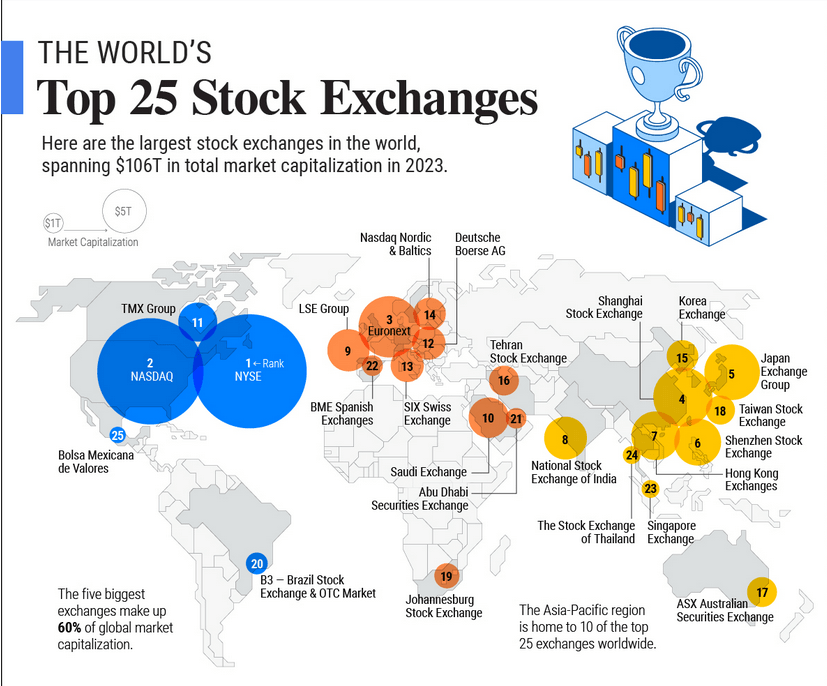
Many upstart exchanges have recently failed. Furthermore, older regional exchanges, like Boston and Philadelphia, which were bought out by the NYSE, no longer exist. However, the odds of success are better for the Texas Stock Exchange due to its backing by Citadel and BlackRock. Blackrock is the world’s largest money management firm, and, therefore, it can shift business toward the new exchange. Citadel is one of the largest electronic trading firms. Ergo, it can also force some of its trades to the new exchange. While the Texas Stock Exchange has financially strong supporters, the Exchange has stiff competition. The graphic below, courtesy of the Visual Capitalist, shows that the NYSE and NASDAQ are the largest stock exchanges in America and the world.
@cnlinkcnlink: Chainlink will power the TXSE. All brokers will have a private chain (think L2) to store customer assets and trade. CCIP will connect all bank chains for settlement. Price data will be provided by Data Streams and guaranteed by staking.
TXSE Group Inc. Announces Plans to Create the Texas Stock Exchange
txse.com: TXSE to provide new trading and listings venue for public companies, ETPs and ADRs
Recently completed capital raise includes global financial institutions, major liquidity providers and prominent business leaders from across the United States.
DALLAS, June 5, 2024 — TXSE Group Inc. announced today that it plans to launch the Texas Stock Exchange (TXSE), headquartered in Dallas. TXSE will focus on enabling U.S. and global companies to access U.S. equity capital markets and will provide a venue to trade and list public companies and the growing universe of exchange-traded products. TXSE will be a fully electronic, national securities exchange that will seek registration with the U.S. Securities and Exchange Commission.
TXSE Group Inc. successfully completed its initial capital raise with participation from more than two dozen investors, including some of the largest financial institutions and liquidity providers in the world, such as BlackRock and Citadel Securities, as well as prominent business leaders from around the country.
The liquidity providers backing TXSE Group Inc. represent a significant portion of the equity volume on U.S. lit exchanges and together comprise a majority of all U.S. listed retail volume. With approximately $120 million of capital raised, TXSE is expected to be the most well-capitalized exchange entrant to file a registration with the U.S. Securities and Exchange Commission.
TXSE’s planned launch comes as changes in the equity markets provide an opportunity for greater alignment and more competition. Corporate issuers and exchange-traded product sponsors are demanding more stability and predictability around listing standards and associated costs. TXSE intends to expand access to U.S. capital markets for all investors, while providing greater access and alignment for public companies and those seeking access to public capital.
“Changes in equities trading markets are driving more volume to exchanges and more choices for issuers and sponsors,” said James Lee, founder and CEO of TXSE Group Inc. “TXSE will ultimately create more competition around quote activity, liquidity and transparency, resulting in more consistent and reliable markets that benefit investors, global issuers and liquidity providers alike.”
Texas and the other states in the southeast quadrant of the U.S. lead the nation in economic expansion and population growth, making Texas the clear choice for the establishment of a new national securities exchange. For decades, Texas has been the nation’s leader in attracting business relocations and expansions. It’s home to more Fortune 500 companies than any other state and more than 5,200 private equity-sponsored companies, many of which are preparing to access the public markets. In addition, there are more than 1,500 publicly traded companies throughout the region.
“We’re thrilled to bring to fruition the long-held vision for a national stock exchange in Texas,” Lee said. “Texas and the other states in the southeast quadrant have become economic powerhouses. Combined with the demand we are seeing from investors and corporations for expanded alternatives to trade and list equities, this is an opportune time to build a major, national stock exchange in Texas.”
TXSE intends to submit a registration with the U.S. Securities and Exchange Commission to operate as a national securities exchange later this year.
About TXSE Group, Inc:
TXSE Group Inc. is the parent company of the Texas Stock Exchange. TXSE will focus on enabling U.S. and global companies to access U.S. equity capital markets and will provide a venue to trade and list public companies and the growing universe of exchange-traded products. Subject to approval by the U.S. Securities and Exchange Commission, TXSE will be a fully electronic, national securities exchange providing access to the U.S. equity markets. More information is available at www.txse.com.
WoodRock Securities (Houston) acted as exclusive financial advisor and sole placement agent for TXSE Group Inc. Cravath, Swaine & Moore (Washington, D.C.) serves as regulatory counsel to the Texas Stock Exchange. The Dallas office of Haynes and Boone LLP served as counsel to TXSE Group Inc. in the offering and will serve as corporate counsel. PwC Consulting serves as managed services provider for TXSE Group Inc.
The southeast quadrant of the U.S. is defined as Texas, Alabama, Arkansas, Florida, Georgia, Louisiana, Mississippi, North Carolina, Oklahoma, South Carolina and Tennessee.
Texas Capital and Governor Abbott Ring The Closing Bell
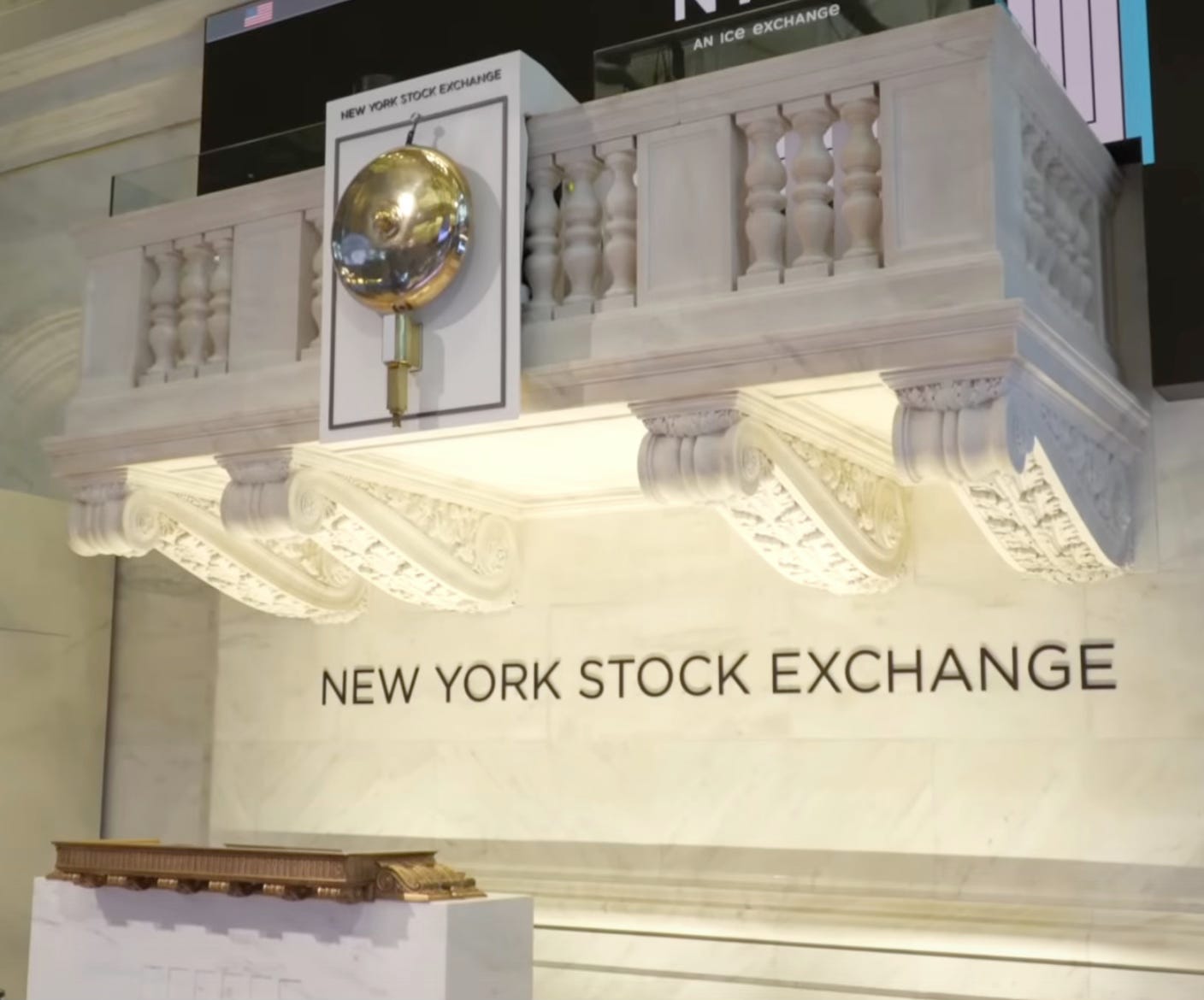
@NYSEofficial: The New York Stock Exchange welcomes Texas Capital to the podium to celebrate the launch of the Texas Capital Texas Equity Index ETF (NYSE Arca: TXS). To honor the occasion, Rob C. Holmes, President & CEO, and Hon. Greg Abbott, Governor of Texas, will ring The Closing Bell®.
The analysis in this material is provided for information only and is not and should not be construed as an offer to sell or the solicitation of an offer to buy any security.
To the extent that this material discusses general market activity, industry or sector trends or other broad-based economic or political conditions, it should not be construed as research or investment advice.
To the extent that it includes references to specific securities, commodities, currencies, or other instruments, those references do not constitute a recommendation to buy, sell or hold such investments.
This material does not and is not intended to take into account the particular financial conditions, investment objectives or requirements of individual customers. Before acting on this material, you should consider whether it is suitable for your particular circumstances and, as necessary, seek professional advice.
Any trading symbols displayed are for illustrative purposes only and are not intended to portray recommendations.